
RAG vs. Fine-Tuning: Stopping the Hype and Architecting for Reality
One of the most expensive mistakes in enterprise AI is using the wrong method to customize a Large Language Model. Here is the definitive mental model for choosing between Retrieval-Augmented Generation and Fine-Tuning.
In the rush to deploy generative AI, a dangerous misconception has taken root among enterprise leaders and even some engineering teams. The belief is that to make an AI model "know" your business, you must train it on your data.
This leads to companies burning significant engineering cycles and compute budgets trying to "teach" foundational models (like GPT-5 or Llama 3) their entire proprietary knowledge base through Fine-Tuning.
Often, this is the wrong approach. It’s akin to buying a Ferrari just to drive in a 20mph zone. expensive, inefficient, and overkill for the actual requirement.
At Sattvabit, we believe in architecting AI solutions based on reality and ROI, not hype. To do that, you need a clear mental model to distinguish between the two primary ways of customizing an LLM: RAG (Retrieval-Augmented Generation) and Fine-Tuning.
The simplest way to understand the difference is with an analogy used by top AI researchers.
The Core Analogy: The Exam Room
Imagine your AI model is a student about to sit a crucial exam that requires specialized knowledge about your company.
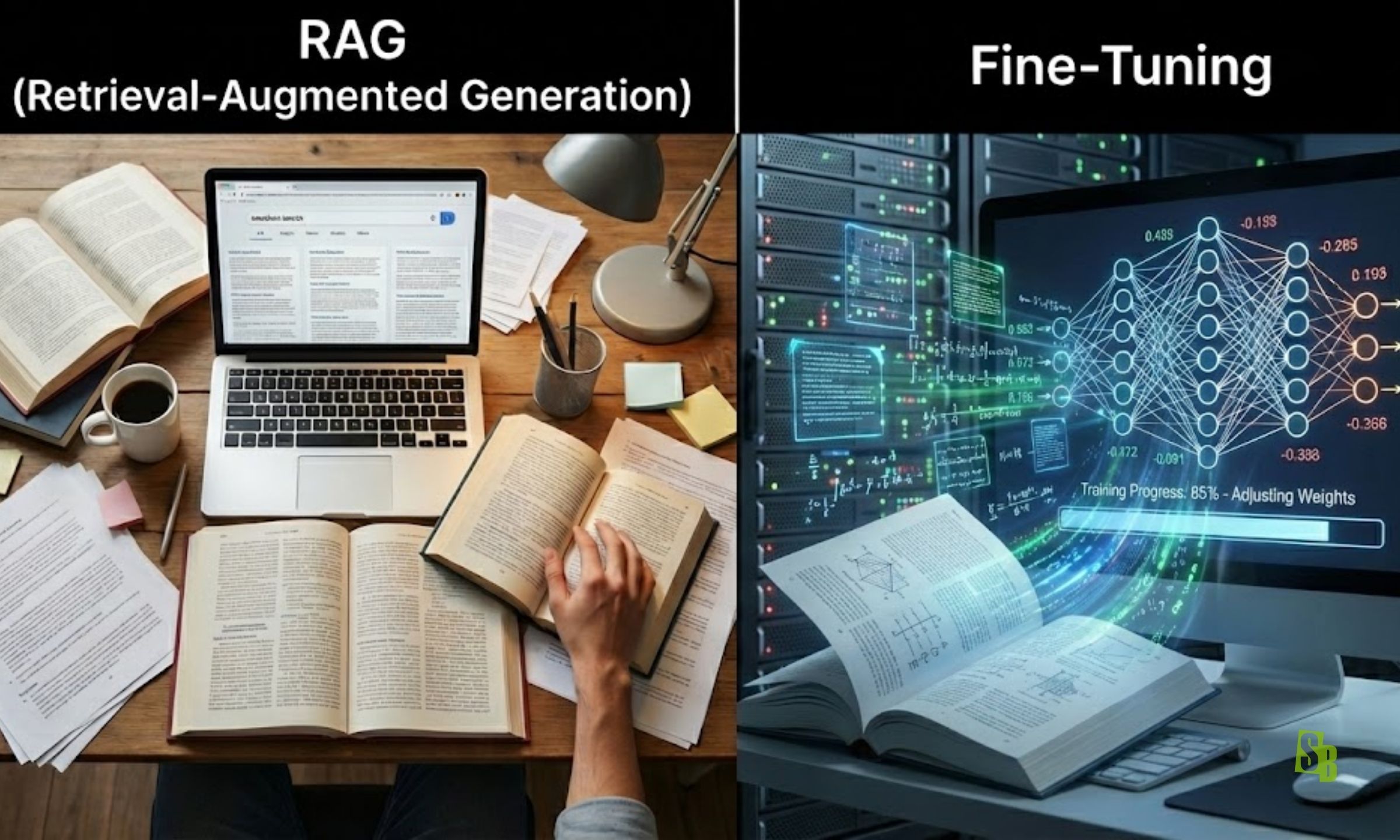
**RAG is the "Open Book Exam" **
In an open-book exam, the student doesn’t need to memorise every single fact. They just need to be skilled at quickly searching through the textbook to find the exact answer.
How it works: When you ask a RAG system a question, it first goes to your private "library" (your vector database containing PDFs, documentation, live data feeds), pulls out the relevant pages, and places them right in front of the AI. The AI then reads that context to generate an accurate answer.
The Advantage: It is grounded in facts. It cites its sources. Crucially, if your data changes tomorrow, the AI knows the new answer instantly without any re-training.
**Fine-Tuning is "Studying for the Exam" **
When you study for a closed-book exam, you read the material repetitively until it is internalised in your long-term memory. You aren't looking anything up during the test; you are relying on altered neural pathways.
How it works: You take a base model and train it further on a specific dataset. This adjusts the model's actual weights—its brain structure—to favor certain types of answers.
The Trap: Many assume this is the best way to teach a model new facts. It isn't. It is rigid and expensive. If a fact changes (e.g., a CEO is replaced, or a regulation updates), the model still "remembers" the old fact until you undergo the expensive process of re-training it.
The Crucial Nuance: Knowledge vs. Behavior
If Fine-Tuning is bad for facts, why does it exist?
Because the analogy needs a slight expansion. Fine-tuning isn't just about memorizing; it's about learning how to take the test.
RAG is superior for Knowledge Retrieval (Facts, dynamic data, specific records).
Fine-Tuning is superior for Behavior Modification (Style, tone, specific output formats, highly technical jargon).
Think of it this way: You send a student to medical school (Fine-Tuning) to learn how to think and speak like a doctor. But when they treat a specific patient, you still hand them that patient's chart (RAG) so they have the correct facts.
A Rule of Thumb for Regulated Sectors
At Sattvabit, we often work with clients in high-stakes, regulated environments like MedTech and CleanTech, where accuracy isn't optional.
Here is the pragmatic rule of thumb we apply when architecting solutions for these sectors:
The Healthcare (MedTech) Approach
Need the AI to check the latest patient vitals against new drug protocols? Use RAG. (The data is dynamic and factual).
Need the AI to write discharge summaries in a very specific clinical format used by your hospital system? Fine-Tune. (The requirement is behavioural and stylistic).
The Renewable Energy (CleanTech) Approach
Need the AI to analyse real-time grid load or spot prices? Use RAG. (The data changes by the minute).
Need the AI to draft technical maintenance logs that adhere to strict regulatory compliance language? Fine-Tune. (The need is for specific terminology and tone).
The Sattvabit View: The Hybrid "Holy Grail"
The most powerful enterprise systems rarely rely on just one approach. The goal isn't to choose between RAG and Fine-Tuning; it's to understand what each tool does best.
Often, the ideal architecture is a hybrid:
We use Fine-Tuning to teach a smaller, more efficient model the specific methodology, jargon, and compliance requirements of your industry. We then equip that highly specialised model with a RAG system, giving it real-time access to your proprietary data.
Don’t pay for an AI to memorise your database. Give it the ability to read it, and teach it the expertise to understand it.
Are you looking to architect an AI solution that balances cutting-edge capability with commercial reality? Contact the Sattvabit team today for an architectural review.